
 Tim Easton
fIREHORSE
Campfire Propaganda/Handmade Records [2026]


“Authentic, analog, and unmistakably Tim Easton.”
Album Overview: Tim Easton grew up the youngest of seven kids, raised in both Tokyo and Akron, Ohio. He graduated from Ohio State with an English degree focused on poetry, then spent seven years playing guitar on the streets of Europe, sometimes busking alongside a pre-fame Beck. When he came back to the States, he recorded his debut solo album, Special 20, in Nashville in 1997 and helped put roots-based singer-songwriter music on the map before the word Americana was stamped on everything. Tim released three albums on New West Records, including one featuring members of Wilco, and toured as an opener for Lucinda Williams and John Hiatt. Since then, he has continued forging his own lane in independent music.
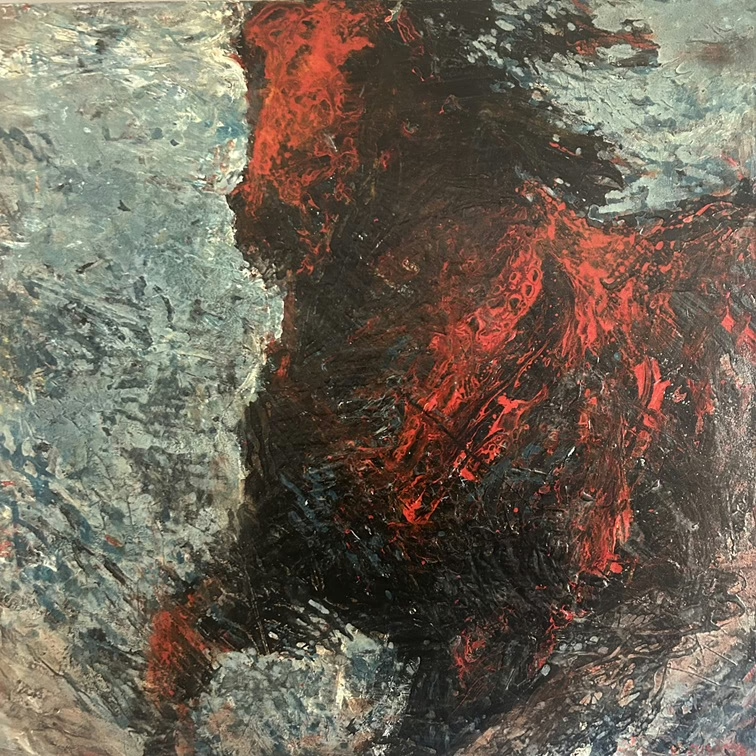
fIREHORSE is Easton’s 14th record and it feels like the work of someone who has nothing left to prove but a lot left to say. The cover art came from a painting by his sister, Susan Easton Burns, made with garden tools rather than brushes, and Easton wrote most of the songs beneath it. Using the rhythm section from Lainey Wilson’s touring band was a smart call. Those players bring a full, road-tested sound that gives the songs real muscle without crowding them, and producer Kevin Nolan ties it all together cleanly. The album drops right as the Chinese calendar enters the Year of the Fire Horse — the same sign Easton was born under in 1966. Whether that is cosmic timing or just a good story, it fits the record well.
Musical Style: fIREHORSE moves around a lot, but it never loses its footing. There is country blues, folk, straight-ahead rock, and hints of classic pop — sometimes all within the same stretch of the record. Producer Kevin Nolan brought in the rhythm section from Lainey Wilson’s touring band, and they lock in tight without ever overplaying. The result is a record that sounds bigger than its budget probably was. Vintage instruments show up throughout: a 1960s Kay acoustic run through an old Fender tube amp, a Maestro Rhythm King drum machine, a rubber bridge guitar, and a Leslie speaker rotating on an electric guitar solo. With carefully placed backing vocals across several tracks, fIREHORSE carries a warm, vinyl-like feel.
Evolution of Sound: Easton has always been a road-worn storyteller, but fIREHORSE finds him pulling from more places at once than usual. Some of his records leaned harder into stripped-down folk and Americana. Here, the production is fuller and the arrangements have more room to move. The blues influence runs deeper. Songs shift gears quickly from one track to the next, and that variety keeps the album moving without feeling scattered. He has also gotten more direct with his lyrics over the years that give it to you straight with more plain talk about real things. That plainness is not a step backward. It actually makes the songs hit harder.
Artists with Similar Fire: Fans of John Hiatt, Steve Earle, and early Lucinda Williams will easily connect here with Tim. There are also moments that echo Guy Clark’s conversational songwriting and the laid-back groove of Little Feat. Jeff Tweedy’s instinct for finding the emotional center of a song without overreaching comes to mind more than once across this record. Easton shares that same restraint. Townes Van Zandt is another voice that comes to mind, not just because Easton opened shows for him early in his career, but because both writers lean on plainspoken truth over clever wordplay. If you are a Jason Isbell fan who wants something a little more road-worn and less polished, Easton covers similar emotional ground with a few more miles on it.
Pivotal Tracks: My favorite track on the album has to be “615 Heartbreaker” as it opens with a skipping Hank Williams needle drop and a backwards piano completed with a smoldering groove. Easton’s smart attitude carries the track as the Maestro Rhythm King drum machine gives it a vintage, chugging swing that sticks with you. “Heaven & Hell” is the most pop-leaning track on the record and earns it as it is built around a phrase his daughter said as a toddler that Easton sat on for over a decade before the song finally came together. Jeremy Lister’s backing vocals push it over the top. “Don’t Let Your Mind Grow Dark” was written and taught to the band on the last day of sessions, and you would never know it. It moves fast, lifts you up, and is one of the most fully realized things on the album.
“Hallelujah” opens with the 1989 Romanian revolution — something Easton watched unfold from the streets of Europe as a young street musician — and that kind of specific, lived detail gives the song a weight that most spiritual tracks never find. It is not preachy, just honest. The record closes with “HWY 62 Love Song,” a tribute to Easton’s seven years living out in the High Mojave desert near Joshua Tree. It is unhurried and wide open, has some of the best sing along moments and after ten tracks of travel, loss, and hard living, it lands like a long exhale. The right song to end on.
Lyrical Strength: Easton studied poetry in college and it shows, but not in a way that makes the songs feel academic. He writes the way someone talks when they have been through something and thought hard about it. “River” uses a question-and-answer structure to mimic the feeling of fast water. “Another Good Man Down” takes on cartel violence without turning it into a romance, which is harder to pull off than it sounds. These kind of specific, lived detail is what separates his writing from a lot of what passes for Americana storytelling these days.
Final Groove: fIREHORSE is not a record that asks for your attention by being flashy. It earns it by being consistently good from start to finish. For a guy running his own label, booking his own shows, and still living gig to gig at this point in his career, the production quality alone is impressive. You would never guess the budget was tight. Easton has been making records for nearly thirty years now and this is one of his stronger ones. With more dates planned on the road, it will be worth watching how these songs develop in a live room — because if his track record holds, they will only get better.
TIM EASTON REVIEW HISTORY
Find Your Way (2024) / You Don’t Really Know Me (2021) / Paco & The Melodic Polaroids (2018) / American Fork (2016) / Haynes Boys: “ST” (2015) / Easton Stagger Phillips: Resolution Road (2014) / Not Cool (2013) / Before The Revolution: The Best Of 1998-2011 (2013)
TIM EASTON LINKS
Website | Facebook | Bandcamp

A lifelong fan of new music—spent the '90s working in a record store and producing alternative video shows. In the 2000s, that passion shifted online with blogging, diving headfirst into the indie scene and always on the lookout for the next great release. Still here, still listening, and still sharing the best of what’s new.
- Christopher Anthonyhttps://thefirenote.com/author/canthony/

- Christopher Anthonyhttps://thefirenote.com/author/canthony/

- Christopher Anthonyhttps://thefirenote.com/author/canthony/
- Christopher Anthonyhttps://thefirenote.com/author/canthony/