
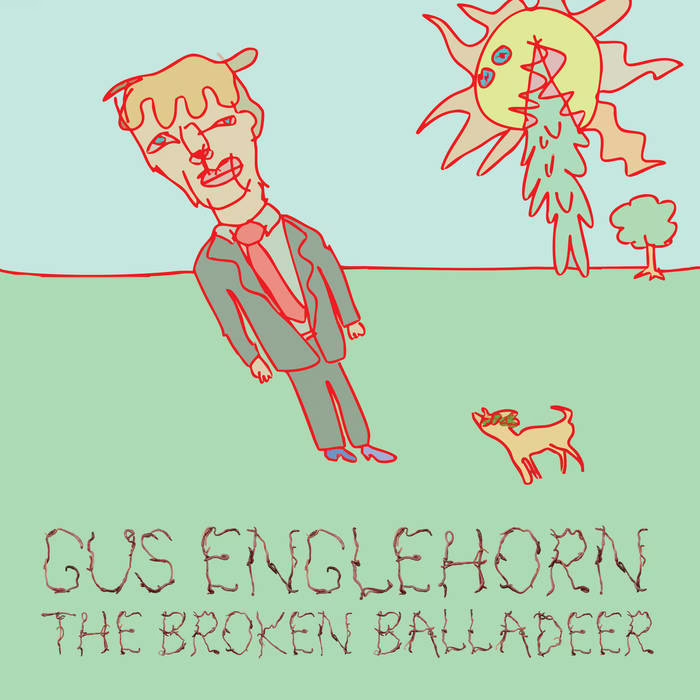
The Broken Balladeer
Gus Englehorn — 2026
Gus Englehorn • The Broken Balladeer • Indie
“Strange, raw, melodic, and impossible to place — The Broken Balladeer is the kind of album that gets better every time you hit play.”
Gus Englehorn grew up in Alaska, split between the Cook Inlet fishing towns and the mountains outside Anchorage. Before he ever picked up a guitar, he was a competitive snowboarder, someone who pushed the limits of that sport until it no longer had enough room for what he wanted to say. So he walked away and started making music. His debut, Death & Transfiguration, arrived in 2020 and immediately turned heads. Dungeon Master followed in 2022, then The Hornbook last year. With each release, Englehorn has tightened his grip while letting his weird streak run wild in the best way. The songs have gotten sharper, the ideas bolder, and the vision clearer.
Now comes The Broken Balladeer, his fourth album and easily his most complete statement yet. The 12-track set was made with producer Paul Leary of the Butthole Surfers, bassist Kramer, mastering engineer Howie Weinberg, and studio veteran Stuart Sullivan. His partner Estée Preda handles drums, keyboards, and Marxophone, adding texture and color to every corner of the record.
What stands out right away is the control. Englehorn sounds locked in. The eccentricity is still there, but it’s focused. He lets these songs stretch out and simmer, building tension before they bloom. It’s a confident move that pays off. The hooks land harder, the moods linger longer, and the album keeps revealing new details with each spin.
There’s a looseness here, but nothing feels accidental. The melodies are easy to hum, the rhythms pull you back in, and the atmosphere is rich without being crowded. It’s the sound of an artist who knows exactly what kind of record he wants to make and goes for it.
The Broken Balladeer lives somewhere between psych rock, post punk, and dusty folk storytelling. The guitars sometimes ring like an old country record, but the songs refuse to park in one lane. Paul Leary’s production keeps the edges rough without letting anything fall apart. The arrangements have space. The melodies lift. Estée Preda’s drumming is steady but never predictable, and the Marxophone and Omnichord add strange little flashes that give the album its own fingerprint. It feels loose and alive, like these songs were played in a room with the amps humming, not pieced together on a screen.
Compared to The Hornbook, which felt like a tour through different corners of rock history, The Broken Balladeer turns inward. The earlier records leaned harder into chaos. This one still has bite, but it moves with more purpose and slows down when it needs to. Englehorn sounds road worn in a good way, like someone who has spent time drifting and finally has the perspective to write about it. Having Leary involved from the start makes a difference too. The songs feel more shaped, more patient. There’s air between the instruments, and that space lets the emotions land.
If you connect with Bill Callahan or Silver Jews, this record will be in your wheelhouse. There’s a little of The Unicorns in the sideways charm, and you can hear Jonathan Richman in the way Englehorn tells a story without trying to show off. Fans of Paul Westerberg’s solo work or the heartfelt oddness of Daniel Johnston or Cameron Winter will find plenty to like here. Leary’s Butthole Surfers background does not show up as noise for the sake of noise. It shows up in the willingness to take a left turn when you expect a right one.
“Pepperina” is the early standout. Englehorn once described it as a Western villain singing to two lovers tied to chairs, and it carries that swagger. It feels more like a character stepping into the spotlight than a standard verse and chorus tune. “Hounds Are Out” kicks the door open with tense, guitar driven urgency before breaking into a chorus that begs to be shouted at full volume. “In the Gorge” pulls everything back and delivers some of the heaviest writing on the album. The title track, “The Broken Balladeer,” closes things with gentle piano and a sense of resolution that feels earned, not polished to perfection. And “Sound of Syrup” blooms in your headphones, one of those songs that sneaks up on you and demands another spin. Honestly, there are no throwaways here.
Englehorn writes like someone who notices small details and trusts them to carry weight. A line like “I’m homesick but I haven’t got a home” lands because it is simple and direct. He does not dress things up just to sound clever. There is sadness woven through the album, but it never slips into self pity. Even when he sings about feeling stuck, there is forward motion. That balance gives the record its backbone.
The Broken Balladeer is simply a really good record. It feels like the moment when everything clicks. The songwriting, Preda’s playing, and Leary’s steady hand all line up. It is strange but grounded, personal but still wide open. A few tracks may take time to fully reveal themselves, but that is part of the pull. With four albums in, Englehorn sounds confident and far from done. With four albums now and a clear creative direction, it will be worth watching where Englehorn takes things next, because he sounds far from finished.

| gus englehorn Links: | Website | BANDCAMP |
| Artist Review History: | The Hornbook (2025) | Dungeon Master (2022) |

Thomas Wilde thrives on the endless variety of the NYC music scene, where every night out reshapes his taste. Writing for TFN lets him share those discoveries, and in his downtime, he’s crate-digging for rare pressings to feed his ever-growing vinyl obsession.
- Thomas Wildehttps://thefirenote.com/author/twilde/
- Thomas Wildehttps://thefirenote.com/author/twilde/

- Thomas Wildehttps://thefirenote.com/author/twilde/
- Thomas Wildehttps://thefirenote.com/author/twilde/