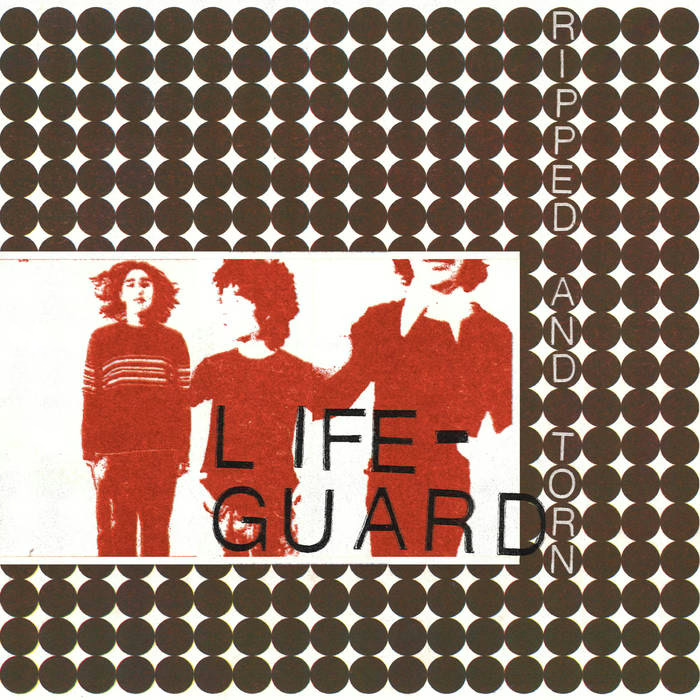
 Lifeguard
Ripped And Torn
Matador Records [2025]


“A post-punk fever dream—fractured, fearless, and totally electric.”
Album Overview: Lifeguard formed in Chicago when its members—Asher Case, Isaac Lowenstein, and Kai Slater—were still teenagers, cutting their teeth in the city’s youth scene at school gyms and DIY spaces. That early connection built the tight chemistry you can hear in every note. Now signed to Matador, the trio make good on all that promise with Ripped and Torn, their debut full-length. It’s a brash, unpredictable record that channels their onstage volatility into something more nuanced and fully formed.
Guitarist Kai Slater is also well known for his other band, Sharp Pins, whose Radio DDR reissue earlier this year put a well-deserved spotlight on his vintage power pop flair. But here, it’s the full-band dynamic that shines. Produced by Randy Randall of No Age, Ripped and Torn blends the trio’s live-wire energy with fractured, ambitious song structures. It thrashes, twitches, and sprawls—sometimes all in the same track. Moments of chaos give way to eerie clarity, and that push-pull is what gives the album its staying power. It feels built from scraps of post-punk history, yet lands somewhere unmistakably new. That’s no small feat in 2025’s indie rock landscape.
Musical Style: Lifeguard play with contrast. One minute you’re in a burst of jagged punk energy, the next you’re floating through a warped, tape-damaged detour. Bass often drives the melody, while drums sneak into melodic roles, and the guitar hacks in like it’s trying to claw out of the mix. Electronic glitches, synth blips, and unexpected textures give the songs a loose, shape-shifting quality. Just when you think you’ve got them figured out, they swerve.
Evolution of Sound: Earlier Lifeguard recordings were all about speed and adrenaline. On Ripped and Torn, they open things up. Songs stretch into noisier, more experimental territory, showing the band isn’t just leveling up—they’re morphing. The use of synths, tape warps, and sonic detours suggests they’re not just refining their sound; they’re actively breaking it apart to find something new inside. It’s a risk that pays off.
Artists with Similar Fire: Lifeguard’s sound carries the same jittery, deconstructed energy found in classic English experimental acts like This Heat and Swell Maps. Both of those groups thrived in the late ’70s and early ’80s UK underground, breaking punk’s rulebook with noisy collage, tape manipulations, and a stubborn refusal to color inside the lines. Lifeguard borrows from both playbooks, channeling that same tension between control and collapse. There’s also a direct lineage to Wire’s angular minimalism, Gang of Four’s danceable abrasion, and the scorched-earth improvisation of The Dead C. The fuzzed-out, exploratory guitar work nods to early Sonic Youth, especially in the way noise is used as both texture and tension. More modern touchpoints include No Age, with whom they share producer Randy Randall, and Women, whose haunting, fragmented soundworld feels spiritually connected. If you gravitate toward bands that treat punk as a launching pad instead of a genre box, Lifeguard fits right into that lineage—cutting their own path while paying homage to the innovators who ripped it all open first.
Pivotal Tracks: “It’ll Get Worse” kicks the door in with sharp-edged urgency—it really sets the tone like a flare gun. “Ripped + Torn” comes late in the record and flips the script with dual paths—vocals and instruments seem to diverge, yet still move in tense sync. “How to Say Deisar” throws a curveball with a beat that recalls The Rapture or The Faint, turning the chaos into a dancefloor head trip. “Music for 3 Drums” is a jittery percussive sketch that widens their sonic range. “Like You’ll Lose” floats a fragile, almost robotic melody through layers of grainy static. Closer “T.L.A.” gets weird in the best way—strange vocal phrasing and warped pacing create a mood that’s equal parts chant, dirge, and breakdown.
Lyrical Strength: Lifeguard aren’t telling stories so much as setting scenes. Lyrics come in fragments, repeated phrases, and half-heard thoughts. They act more like another instrument than a narrative guide, pulling weight through tone and delivery. The ambiguity works—it gives the record an emotional pulse that hits harder than anything too literal. When the band sounds unsettled, you feel it in your gut.
Final Groove: Ripped and Torn is a shot of adrenaline filtered through a kaleidoscope. It’s raw, inventive, and just a little unhinged—exactly what you want from a young band pushing boundaries. Lifeguard aren’t just another post-punk revival act; they’re building their own language out of broken rhythms and noise-drenched experiments. The future they’re pointing toward might be messy, but if this debut is any indication, it’s going to be thrilling to watch unfold.
LIFEGUARD LINKS
Instagram | Bandcamp | Matador Records

A lifelong fan of new music—spent the '90s working in a record store and producing alternative video shows. In the 2000s, that passion shifted online with blogging, diving headfirst into the indie scene and always on the lookout for the next great release. Still here, still listening, and still sharing the best of what’s new.
- Christopher Anthonyhttps://thefirenote.com/author/canthony/
- Christopher Anthonyhttps://thefirenote.com/author/canthony/

- Christopher Anthonyhttps://thefirenote.com/author/canthony/
- Christopher Anthonyhttps://thefirenote.com/author/canthony/